
 English
 Español
 Français
 العربية


colorimeter
A colorimeter is an optical instrument used to measure and compare the color of substances with high consistency and precision. It plays an important role in many fields where accurate color evaluation is necessary, such as food processing, printing, textiles, plastics, paints, cosmetics, and scientific research. By converting visible color information into numerical data, a colorimeter helps remove subjective judgment and makes color analysis more objective and reliable.The basic principle of a colorimeter is to illuminate a sample with a standard light source and then detect the light reflected from or transmitted through the sample. The instrument usually contains filters, sensors, and an electronic processing system that works together to analyze the color response. The measured result is often expressed in color spaces such as CIE Lab, which includes lightness and chromatic coordinates. These values allow users to compare one sample with a reference standard and determine whether there is a noticeable color difference.One of the main advantages of a colorimeter is its simplicity and ease of use. Compared with more advanced spectrophotometric equipment, a colorimeter is often more compact, faster, and more affordable. It is suitable for routine quality control, especially when the main requirement is to check color consistency rather than to perform highly detailed spectral analysis. Operators can usually complete measurements quickly, making it ideal for production environments where efficiency is important.In industrial applications, colorimeters help maintain product quality and brand consistency. For example, in textile manufacturing, they ensure that dyed fabrics match the required shade. In the paint industry, they are used to verify that batches remain uniform. In food production, they can be used to monitor the appearance of ingredients and finished products, since color often influences consumer perception. In cosmetics, accurate color matching is essential for foundations, lip products, and other items where appearance is a key factor.A colorimeter is also useful in laboratory settings. Researchers may use it to study chemical reactions, measure concentration changes, or analyze biological samples. In education, it serves as a practical tool for teaching principles of light, color, and measurement. Because it provides numerical output, it supports data recording, comparison, and statistical analysis.Although colorimeters are very useful, they have some limitations. They may not capture the full complexity of color in the same way as more advanced instruments, especially for samples with unusual surface textures, fluorescence, or highly complex spectral properties. Proper calibration is also important, since inaccurate calibration can lead to unreliable results. Sample preparation, lighting conditions, and measurement geometry can all influence the final reading.Overall, a colorimeter is a valuable instrument for anyone who needs fast, repeatable, and objective color measurement. Its combination of practicality, accuracy, and efficiency makes it an essential tool in modern quality control and scientific analysis.
продукт
классификация:
-
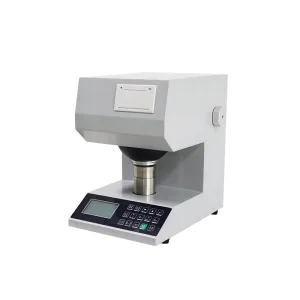
Whiteness and Color Tester
Их классификация: Tissue & Hygiene Product Testing Instrumentsмнения: 216номер:Время выпуска: 2026-07-21 11:45:55The Whiteness and Color Tester is a multi-functional optical property testing instrument widely used in industries such as papermaking, printing, textile dyeing, ceramics, building materials, chemicals, grain, and salt production. It measures blue-light whiteness, Hunter whiteness, yellowness, color, and color difference, as well as paper opacity, transparency, light scattering coefficient, light absorption coefficient, and ink absorption value. The instrument uses a simulated D65 illuminant and d/o illumination viewing geometry (integrating sphere diameter 150mm, measurement port diameter 25mm) with a built-in light absorber to eliminate specular reflection effects. It adopts the CIE 1964 supplementary colorimetric system and CIE 1976 (L*a*b*) color space formula. Measurement repeatability is ≤0.10 with high accuracy. The instrument stores up to 10 reference sample values in non-volatile memory, supports digital display and report printing. Compliant with dozens of national and international standards including GB/T 7973, GB/T 7974, ISO 2470, and ISO 2471, it is the standardized instrument for whiteness and color testing across multiple industries.
новости
классификация:
Нет результатов поиска!
случай
классификация:
Нет результатов поиска!
видео
классификация:
Нет результатов поиска!
скачать
классификация:
Нет результатов поиска!
вербовка
классификация:
Нет результатов поиска!
Рекомендуемые продукты
Нет результатов поиска!



 телефон