
 English
 Español
 Français
 العربية


friction tester
A friction tester is a specialized instrument used to measure the resistance between two surfaces when they move against each other. It is widely applied in material testing, quality control, product development, and research because friction plays an important role in the performance, durability, and safety of many products. By evaluating the coefficient of friction, engineers and technicians can understand how a material behaves under real or simulated conditions and make informed decisions about design and use.The basic principle of a friction tester is simple. One material sample is placed in contact with another surface, and a controlled force or motion is applied. The tester then records the amount of resistance generated during sliding or motion. This resistance is known as friction force. From the measured force, the coefficient of friction can be calculated. There are usually two values of interest: static friction and dynamic friction. Static friction refers to the force needed to start motion, while dynamic friction refers to the force required to maintain movement once sliding has begun.Friction testers come in different forms depending on the type of test required. Some are designed for flat materials such as films, sheets, paper, textiles, or packaging materials. Others are used for rubber, plastics, coatings, metals, or lubricated parts. A typical friction tester may include a test platform, a sliding mechanism, a load system, sensors, and a control interface. Modern models often feature digital displays, automatic data collection, and software for analysis, making the testing process more accurate and efficient.These instruments are especially valuable in industries where surface interaction affects product quality. For example, in packaging, friction testing helps determine whether materials will slip too easily or stick too much during processing and transport. In the automotive field, it can be used to study tire materials, brake components, and interior surfaces. In electronics and consumer goods, friction properties influence handling, assembly, and user experience. In textiles and paper products, the tactile feel and movement between layers are often directly related to friction performance.Another important advantage of a friction tester is its ability to provide repeatable and objective results. Human judgment about slipperiness or roughness can vary, but an instrument-based test gives consistent measurements under controlled conditions. This helps manufacturers compare different materials, monitor production consistency, and meet technical standards. It also supports research into new surface treatments, coatings, and additives designed to change friction behavior.Proper testing conditions are essential for reliable results. Factors such as temperature, humidity, surface cleanliness, test speed, and applied load can all influence friction measurements. Therefore, samples should be prepared carefully, and test procedures should follow standard methods when possible. This ensures that results are meaningful and comparable.In summary, a friction tester is an important tool for measuring how surfaces interact during motion. It helps users understand static and dynamic friction, improve material performance, and ensure product quality across many applications. Through accurate and repeatable testing, it supports both industrial production and scientific research.
продукт
классификация:
-
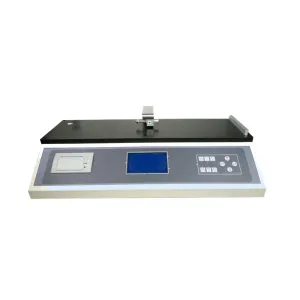
Friction Coefficient Teste
Их классификация: Paper Testing Instrumentsмнения: 205номер:Время выпуска: 2026-08-10 10:33:48The Friction Coefficient Tester is a precision testing instrument specifically designed for measuring the static and kinetic friction coefficients of plastic films, sheets, and other similar materials during sliding. The instrument fully complies with GB/T 17200-2008, GB/T 10006-2021, and ISO 8295:1995 standards. It uses microcomputer control for fully automated testing. Equipped with a PVC control panel and LCD display, it shows real-time test results, parameter settings, and force curves. A high-precision imported sensor provides measurement accuracy of 0.001N within a force range of 0-10N. The sled dimensions are 63×63mm with a mass of 200±2g, an effective stroke of 70mm, and a sled speed of 100mm/min±1%. The test stroke is freely settable from 0-320mm. The instrument features fully digital control with no mechanical knobs. It has built-in data statistical analysis functions to automatically calculate static and kinetic friction coefficients. A micro-printer and RS232 serial port are included for real-time data printing and external computer data acquisition. Overall dimensions are 480×320×300mm with a weight of 35kg. This instrument is an ideal standard device for material surface slip performance testing in the plastic packaging, film manufacturing, quality inspection, and scientific research industries.
новости
классификация:
Нет результатов поиска!
случай
классификация:
Нет результатов поиска!
видео
классификация:
Нет результатов поиска!
скачать
классификация:
Нет результатов поиска!
вербовка
классификация:
Нет результатов поиска!
Рекомендуемые продукты
Нет результатов поиска!



 телефон