
 English
 Español
 Français
 العربية


laboratory coating machine
A laboratory coating machine is a specialized piece of equipment designed to apply a thin and uniform layer of material onto a substrate under controlled conditions. It is widely used in research, product development, quality testing, and small-scale production. By precisely managing coating thickness, speed, temperature, and drying conditions, the machine helps users evaluate coating performance and improve process consistency.This type of equipment is commonly used in laboratories involving films, papers, textiles, plastics, batteries, electronics, pharmaceuticals, and advanced materials. It can be used for a variety of coating methods, such as slot die coating, knife coating, roll coating, spray coating, or dip coating, depending on the application and the material being processed. The flexibility of the machine makes it suitable for both water-based and solvent-based materials, as well as viscous pastes, slurries, and functional inks.A laboratory coating machine usually includes a stable frame, a coating head, a substrate holding platform, a feeding or dispensing system, and a control panel. Some models also feature heating zones, vacuum suction tables, adjustable speed control, and programmable operation settings. These functions allow researchers to achieve accurate coating results and repeat experiments with high reliability. The machine is often designed for easy adjustment, so users can quickly change coating width, gap height, coating speed, and drying parameters.One of the main advantages of a laboratory coating machine is its ability to produce consistent and reproducible coatings with minimal material waste. This is especially important in early-stage development, where only small quantities of expensive raw materials may be available. The machine also helps reduce manual errors and improves the efficiency of laboratory testing. With precise control, users can compare different formulations and coating conditions more effectively.In addition, laboratory coating machines are valuable for simulating industrial production processes on a smaller scale. This allows engineers and scientists to study how a material behaves during coating, drying, and curing before moving to full-scale manufacturing. As a result, they can save time, reduce costs, and improve product quality.Overall, a laboratory coating machine is an essential tool for modern research and development. It provides accuracy, flexibility, and repeatability, making it ideal for a wide range of scientific and industrial applications.
продукт
классификация:
-
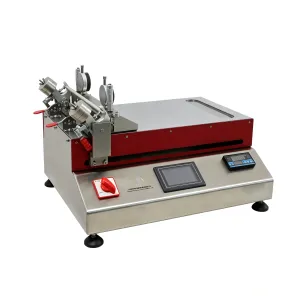
Планшетный тестер покрытий (высокая точность)
Их классификация: Coating & Film Applicatorsмнения: 379номер:Время выпуска: 2026-06-04 15:22:40Серия AT-TB-2100 — это высокоточное лабораторное планшетное устройство для нанесения покрытий, разработанное компанией Shandong Annimet и предназначенное для пробного нанесения покрытий, разработки процессов и контроля качества покрытий, клеев, термоплавких материалов и проводящих/наноматериалов на таких подложках, как бумага, нетканые материалы, сетка, стекло и металлическая фольга. Имея регулируемую скорость от 1 до 2000 мм/мин и эффективную площадь 300×400 мм, он предлагает дополнительную вакуумную адсорбцию и платформу с подогревом до 200°C, управление рецептами с помощью сенсорного экрана и заменяет ручную раздачу повторяемыми, высокоточными и однородными образцами покрытия.
новости
классификация:
-
[industry news]5 факторов, которые следует учитывать при выборе лабораторно...
2026-06-17 16:33:37 -
[industry news]Laboratory Coating Machine: Essential Tool for R&D and Quali...
2026-07-28 23:21:04
случай
классификация:
Нет результатов поиска!
видео
классификация:
Нет результатов поиска!
скачать
классификация:
Нет результатов поиска!
вербовка
классификация:
Нет результатов поиска!
Рекомендуемые продукты
-
NEWS
Планшетный тестер покрытий (высокая точность)
Узнать больше



 телефон