
 English
 Español
 Français
 العربية


MIT folding tester
A folding tester is a specialized instrument used to evaluate the durability and flexibility of paper, paperboard, films, and other sheet-like materials by repeatedly folding a specimen under controlled conditions. It is commonly used in quality control, research, and product development to determine how well a material can withstand repeated bending before it breaks, cracks, or shows signs of fatigue. The results help manufacturers compare material grades, assess production consistency, and predict performance in real-world use.The basic principle of a folding tester is simple: a sample is clamped into the machine and folded back and forth along the same line or in a controlled pattern until failure occurs or until a specified number of cycles is reached. During the test, the device applies a constant and repeatable motion so that every sample is subjected to the same stress. This ensures that the data collected is reliable and can be compared across different batches or products.A folding tester usually includes a sample clamping system, a folding mechanism, a counting or measuring unit, and a control interface. Some models allow the user to adjust folding speed, angle, pressure, and test frequency depending on the material being tested. Advanced versions may include digital displays, programmable settings, automatic shutdown at failure, and data output for analysis. These features improve accuracy and make the testing process more efficient.This instrument is especially important for materials that are expected to endure repeated handling, packaging, or movement. In the paper industry, for example, folding endurance is an important indicator of fiber strength and internal bonding. A sheet with high folding endurance is more likely to perform well during printing, conversion, packaging, and storage. In other industries, folding testers are also used for flexible packaging materials, thin plastics, coated papers, leather-like materials, and laminated products.Testing standards are often used to ensure consistency. Depending on the application, samples may be conditioned under specific temperature and humidity levels before testing. This is because environmental factors can significantly affect folding performance. By following standardized procedures, laboratories can obtain more meaningful and reproducible results.The advantages of a folding tester include ease of operation, high repeatability, and the ability to provide quantitative performance data. It helps identify weaknesses in material structure, compare different formulations, and support product improvement. By detecting poor folding resistance early, companies can reduce waste, improve reliability, and enhance customer satisfaction.In summary, a folding tester is an essential laboratory tool for measuring the folding endurance of sheet materials. It plays a key role in material evaluation, quality assurance, and product development. Its controlled testing process and accurate results make it valuable for any application where flexibility and resistance to repeated folding are important.
продукт
классификация:
-
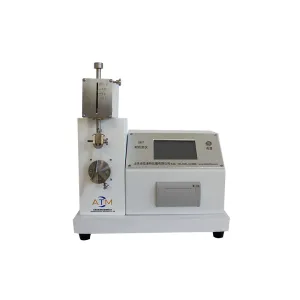
Automatic Folding Endurance Tester
Их классификация: Paper Testing Instrumentsмнения: 175номер:Время выпуска: 2026-08-11 09:09:31The Automatic Folding Endurance Tester is an upgraded version of the AT-NZ-1, designed and manufactured in accordance with the national standard GB/T 457-2008 (Paper and board — Determination of folding endurance). It is specifically used for testing the folding endurance of paper and paperboard. The instrument features an imported servo motor with direct drive, completing the 135±2° folding angle conversion directly on the motor shaft, thereby eliminating the noise and wear issues associated with traditional mechanical conversion methods. The folding speed is settable at 175±10 folds/min, the folding head width is 19±1mm, and the fold radius is 0.38±0.02mm. The spring tension is adjustable from 4.91 to 14.72N, with fold gap distances selectable from 0.25-1.00mm. The measuring range is 0-99999 folds. The instrument is equipped with a touchscreen control system and Annimet testing control software V1.0, supporting tabular data processing with automatic calculation of maximum, minimum, average, and coefficient of variation, along with force-displacement and force-time curve displays. Photoelectric control technology ensures the folding clamp automatically returns to its initial position after each test. A built-in micro-printer is standard, with optional WIFI/USB/remote transmission. Overall dimensions are 380×280×430mm. This instrument is commonly used in paper mills, box plants, research institutes, and universities.
новости
классификация:
Нет результатов поиска!
случай
классификация:
Нет результатов поиска!
видео
классификация:
Нет результатов поиска!
скачать
классификация:
Нет результатов поиска!
вербовка
классификация:
Нет результатов поиска!
Рекомендуемые продукты
Нет результатов поиска!



 телефон