
 English
 Español
 Français
 العربية


standard disintegrator
A standard disintegrator is a mechanical processing device designed to break down, disperse, or reduce solid materials into smaller particles through repeated impact, cutting, shear, or friction. It is widely used in laboratories, pilot plants, and industrial production settings where precise material size reduction is required. The machine is typically valued for its ability to handle a variety of raw materials, including dry powders, granules, fibrous substances, and some brittle solids. By converting larger particles into a more uniform and manageable form, the disintegrator helps improve product consistency, enhance mixing efficiency, and support downstream processing.The basic structure of a standard disintegrator usually includes a motor, a rotating rotor or blade assembly, a chamber for material processing, and a feeding and discharge system. When the machine operates, the motor drives the internal cutting or striking components at high speed. Materials entering the chamber are repeatedly subjected to mechanical force, causing them to fracture or separate into finer particles. Depending on the design, screens or sieves may be installed to control the final particle size. Once the material reaches the required level of reduction, it is discharged from the chamber for further use or packaging.One of the main advantages of a standard disintegrator is its versatility. It can be used in different industries for different purposes, such as preparing raw materials for blending, improving solubility, or making particles more suitable for pressing, granulating, or extracting. In food processing, it can help break down ingredients to improve texture and uniformity. In pharmaceutical and chemical applications, it is often used to prepare materials for formulation and testing. In research environments, it provides a reliable method for sample preparation and controlled particle-size reduction.Another important feature is operational efficiency. A standard disintegrator is generally designed for stable performance, easy operation, and relatively low maintenance. The user can often adjust parameters such as speed, feed rate, or screen size to achieve the desired output. Many models also include safety mechanisms to protect the operator and ensure consistent processing. Depending on the application, the machine may be built from stainless steel or other durable materials to resist wear, corrosion, and contamination.In summary, a standard disintegrator is a practical and effective piece of equipment for material breakdown and particle reduction. Its simple working principle, broad application range, and dependable performance make it an essential tool in many production and laboratory environments. Whether used for small-scale testing or continuous industrial processing, it plays an important role in improving material quality and preparing substances for the next stage of manufacturing.
продукт
классификация:
-
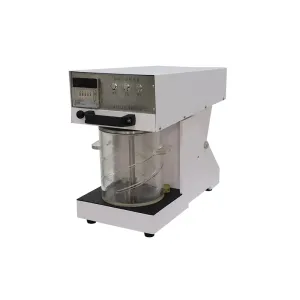
Стандартный дезинтегратор волокна
Их классификация: Pulp Preparation & Sheet Forming Equipmentмнения: 332номер:Время выпуска: 2026-06-03 16:19:01Стандартный дезинтегратор волокна — это специализированное лабораторное устройство для влажной дезинтеграции, соответствующее стандартам GB/T 24327-2009, ISO 5263 и QB/T 1462-1992. Он механически разделяет переплетенные волокна в воде с помощью высокоскоростной вращающейся крыльчатки, максимально сохраняя при этом исходную морфологию и свойства волокон. Обладая емкостью контейнера ≥3 л, скоростью крыльчатки >2950 об/мин и автоматической остановкой оборотов с цифровой предустановкой, он оснащен прозрачным акриловым контейнером и гибкой приводной муфтой для плавной и бесшумной работы. Это важное устройство предварительной обработки для проверки качества целлюлозы.
новости
классификация:
Нет результатов поиска!
случай
классификация:
Нет результатов поиска!
видео
классификация:
Нет результатов поиска!
скачать
классификация:
Нет результатов поиска!
вербовка
классификация:
Нет результатов поиска!
Рекомендуемые продукты
-
NEWS
Стандартный дезинтегратор волокна
Узнать больше



 телефон