
 English
 Español
 Français
 العربية


air permeance tester
An air permeance tester is a specialized laboratory instrument used to measure the amount of air that passes through a material under controlled conditions. It is widely applied in industries such as textiles, paper, nonwovens, filters, leather, building materials, and packaging. By evaluating air permeance, manufacturers and researchers can better understand the breathability, porosity, and overall performance of a product. This information is essential for quality control, product development, and compliance with industry standards.The basic working principle of an air permeance tester is straightforward. A sample is placed over an opening, and air is drawn or forced through it at a specified pressure difference. The instrument then measures the volume of air passing through the material within a set time or under a defined flow condition. The results are usually displayed in units such as L/m²/s, cm³/cm²/s, or other standard units depending on the test method. Some testers can also calculate resistance to airflow, which helps users assess how easily air moves through the sample.Modern air permeance testers are designed for accuracy, repeatability, and ease of use. They often include digital control systems, touch-screen interfaces, automatic pressure regulation, and data storage functions. These features reduce operator error and improve testing efficiency. Many models also support multiple test standards, allowing users to perform tests according to different national and international methods. This flexibility makes the instrument suitable for both routine inspection and research applications.In the textile industry, air permeance testing is important for evaluating comfort and functionality. Fabrics with higher air permeability may feel more breathable and are often preferred for clothing, sportswear, and technical textiles. In contrast, low-permeability fabrics may be used when wind resistance or barrier properties are required. In paper and packaging applications, air permeance can influence printability, absorbency, and product protection. For filter materials, the test helps determine how well a medium balances airflow and filtration efficiency. In construction materials, air permeance is related to insulation performance and energy efficiency.An air permeance tester typically consists of a test head, clamping mechanism, pressure control system, flow measuring device, and software or display unit. The sample must be prepared carefully to avoid wrinkles, leaks, or damage, as these can affect the results. Proper calibration and maintenance are also important to ensure stable performance and reliable data over time.Overall, an air permeance tester is an essential instrument for evaluating how materials interact with air. It provides valuable data that supports product design, quality assurance, and material comparison. With increasing demand for high-performance and functional materials, the role of air permeance testing continues to grow across many industries.
продукт
классификация:
-
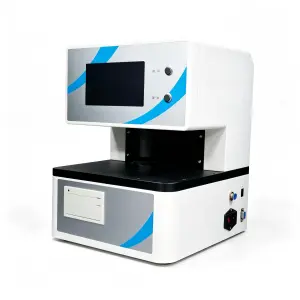
Цифровой тестер воздухопроницаемости
Их классификация: Paper Testing Instrumentsмнения: 369номер:Время выпуска: 2026-06-04 16:55:14Цифровой тестер воздухопроницаемости — это полностью автоматический многофункциональный прибор для тестирования воздухопроницаемости бумаги и картона. Благодаря модульной конструкции он соответствует множеству стандартов и методов испытаний, включая Schober, Gurley и Bendtsen. Диапазон расхода составляет 0–5000 мл/мин, регулируемый диапазон давления от 10 Па до 3 кПа, стандартная эффективная площадь испытания 10,0±0,2 см². Он оснащен автоматическим зажимом образца, управлением с помощью сенсорного экрана, автоматическим считыванием и оценкой результатов, а также дополнительным программным обеспечением для ПК, что делает его комплексной платформой для испытаний бумаги и картона на воздухопроницаемость.
новости
классификация:
Нет результатов поиска!
случай
классификация:
Нет результатов поиска!
видео
классификация:
Нет результатов поиска!
скачать
классификация:
Нет результатов поиска!
вербовка
классификация:
Нет результатов поиска!
Рекомендуемые продукты
-
NEWS
Цифровой тестер воздухопроницаемости
Узнать больше



 телефон