
 English
 Español
 Français
 العربية


benchtop coater
A benchtop coater is a compact and versatile piece of laboratory equipment designed for applying thin, uniform coatings to a variety of substrates. It is commonly used in research, development, quality control, and small-scale production environments where precise and repeatable coating results are required. Its relatively small footprint makes it ideal for use on laboratory benches or in limited workspace, while still providing the performance needed for demanding coating applications.One of the main advantages of a benchtop coater is its ability to deliver consistent film thickness across a surface. Depending on the model and coating method, it can be used to deposit materials such as polymers, inks, adhesives, conductive layers, protective films, or functional materials onto glass, plastic, metal, ceramic, or flexible substrates. This makes it especially valuable in fields such as electronics, materials science, biomedical research, energy devices, and advanced manufacturing.Benchtop coaters are typically designed with user-friendly controls that allow operators to adjust coating speed, pressure, time, temperature, and other process parameters. This flexibility helps users optimize the coating process for different materials and substrate types. Some systems support multiple coating techniques, including blade coating, slot-die coating, spin coating, spray coating, or dip coating, depending on the specific configuration. Such adaptability enables researchers and engineers to test different formulations and coating conditions with high precision.Another important feature is process repeatability. In laboratory and pilot-scale applications, it is essential that each sample receives the same coating quality. A benchtop coater helps reduce human error by automating critical steps and maintaining stable operating conditions. This improves experimental reliability and makes it easier to compare results across multiple samples or batches. In addition, many units are equipped with digital displays, programmable settings, and safety features that enhance ease of use and operational control.Maintenance and cleaning are also important considerations. Benchtop coaters are generally designed for straightforward disassembly and cleaning, especially when used with different coating materials. This helps prevent cross-contamination and supports efficient workflow in busy lab settings. Durable construction and corrosion-resistant materials are often used to ensure long-term performance and compatibility with a range of chemicals and solvents.Overall, a benchtop coater is an essential tool for anyone working with thin-film deposition or surface modification. It combines compact size, precise control, and reliable performance in a single system. Whether used for developing new materials, preparing test samples, or refining coating processes, it offers a practical solution for achieving high-quality coatings in a controlled laboratory environment.
продукт
классификация:
-
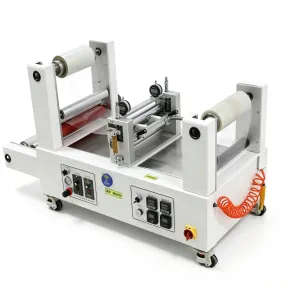
Тестер термоплавкого клея
Их классификация: Coating & Film Applicatorsмнения: 339номер:Время выпуска: 2026-06-04 15:05:38Настольный тестер термоклеевых покрытий представляет собой компактное устройство для нанесения термоклеевых покрытий и ламинирования, а также поверхностного покрытия различных подложек. Клеевой бак термостатически нагревается от комнатной температуры до 180°С, ширина покрытия 300 мм, механическая скорость 100-800 мм/мин, точность нанесения покрытия лучше ±2 мкм. Его настольная конструкция из алюминиевого сплава проста в эксплуатации, что делает его идеальным для лабораторных исследований и разработок клея-расплава.
новости
классификация:
Нет результатов поиска!
случай
классификация:
Нет результатов поиска!
видео
классификация:
Нет результатов поиска!
скачать
классификация:
Нет результатов поиска!
вербовка
классификация:
Нет результатов поиска!
Рекомендуемые продукты
-
NEWS
Тестер термоплавкого клея
Узнать больше



 телефон