
 English
 Español
 Français
 العربية


continuous coater
A continuous coater is a specialized industrial machine designed to apply a uniform layer of material onto a substrate in an uninterrupted process. It is widely used in manufacturing industries where consistent coating quality, high production efficiency, and precise control are essential. Unlike batch coating systems, a continuous coater operates without frequent stops, allowing materials to move steadily through the coating zone. This makes it ideal for large-scale production environments that require stable output and repeatable results.The main function of a continuous coater is to deposit a coating material evenly across a surface such as metal sheet, plastic film, paper, fabric, foil, or other flexible substrates. The coating can serve many purposes, including protection, decoration, electrical insulation, moisture resistance, corrosion resistance, or improved appearance. Depending on the application, the coating material may be liquid, semi-liquid, or powder-based. Common coating methods include roll coating, spray coating, slot-die coating, curtain coating, and dip coating. The specific method used depends on the type of substrate, the desired coating thickness, and the properties of the coating material.A typical continuous coater consists of several key components. These may include an unwinding section for feeding the substrate, a tension control system to maintain smooth material movement, a coating head or applicator, drying or curing equipment, and a rewinding or collection unit. Advanced systems may also include sensors, automatic thickness control, temperature regulation, and digital monitoring interfaces. These features help ensure that the coating is applied consistently and that product quality remains stable throughout the production run.One of the major advantages of a continuous coater is its ability to improve productivity. Because the process runs continuously, it reduces downtime and increases output efficiency. It also helps minimize material waste by providing precise control over coating volume and thickness. In addition, continuous coating systems can improve product consistency, since automation reduces human error and variation between batches. For manufacturers, this translates into lower production costs, better quality control, and more reliable performance.Continuous coaters are used in many industries, including packaging, electronics, automotive, construction, pharmaceuticals, and textiles. In packaging, they may be used to apply barrier layers or adhesive coatings. In electronics, they can coat films used in batteries, displays, or circuit components. In automotive and construction applications, they may provide protective or functional surface layers. In the pharmaceutical field, continuous coating may be used for tablets or medical materials requiring controlled surface treatment.Overall, a continuous coater is an important piece of equipment for modern manufacturing. It combines efficiency, precision, and versatility, making it suitable for a wide range of industrial coating applications. As production demands continue to grow, continuous coating technology remains a valuable solution for achieving high-quality results in a fast and cost-effective manner.
продукт
классификация:
-
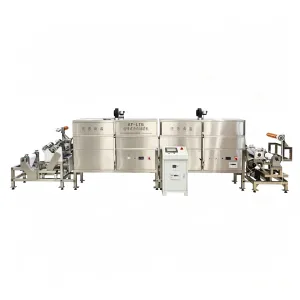
Тестер непрерывного покрытия
Их классификация: Coating & Film Applicatorsмнения: 389номер:Время выпуска: 2026-06-04 15:09:11Устройство для непрерывного нанесения покрытий предназначено для нанесения покрытий с рулона на рулон и ламинирования рулонных подложек. Он поддерживает как методы нанесения покрытия дозирующим стержнем, так и ножом, с эффективной шириной покрытия 280 мм и механической скоростью 0,2-2 м/мин. Оснащенный двумя сушильными печами (30-120°C ±2°C), системами размотки, намотки, ламинирования и электрическим управлением, он обрабатывает бумажные (60-120 г/м2) и пленочные (0,03-0,15 мм) подложки с использованием покрытий на водной основе или на основе растворителей. Это профессиональная платформа для исследований процесса непрерывного нанесения покрытий.
новости
классификация:
Нет результатов поиска!
случай
классификация:
Нет результатов поиска!
видео
классификация:
Нет результатов поиска!
скачать
классификация:
Нет результатов поиска!
вербовка
классификация:
Нет результатов поиска!
Рекомендуемые продукты
-
NEWS
Тестер непрерывного покрытия
Узнать больше



 телефон