
 English
 Español
 Français
 العربية


laboratory film applicator
A laboratory film applicator is a precision instrument used to apply uniform, controlled coatings of liquid materials onto flat substrates. It is commonly used in research, quality control, product development, and testing environments where consistent film thickness is essential. By allowing a sample solution, ink, adhesive, paint, slurry, or other coating material to be spread evenly across a surface, the device helps ensure repeatable results and reliable comparison between experiments.The main purpose of a laboratory film applicator is to create a smooth and consistent film with a defined thickness. In many cases, the applicator is used together with glass plates, metal panels, polymer sheets, or other test substrates. The user places a measured amount of material near one end of the surface and then draws the applicator across it at a controlled speed or pressure. Depending on the design, the film thickness may be determined by an adjustable gap, fixed blade spacing, or other precision mechanism. This makes it possible to produce coatings that are highly uniform and suitable for further analysis.A laboratory film applicator is widely used in fields such as coatings, printing, pharmaceuticals, electronics, batteries, adhesives, and materials science. In coating research, it helps evaluate viscosity, drying behavior, adhesion, gloss, and surface quality. In the pharmaceutical industry, it may be used to prepare thin films for drug formulation studies or transdermal delivery testing. In printing and packaging applications, it supports the preparation of test layers for inks, varnishes, and protective films. In battery and electronics development, it is useful for producing electrode slurries or functional coatings on substrates.One of the key advantages of a laboratory film applicator is its ability to improve repeatability. Manual coating methods often produce uneven layers, streaks, bubbles, or inconsistent thickness. A well-designed applicator reduces these issues by providing a stable and controlled application process. This helps researchers obtain more accurate experimental data and compare formulations under the same conditions. It also saves time by reducing the need to repeat tests due to poor coating quality.Laboratory film applicators are typically made from durable and chemically resistant materials such as stainless steel, aluminum, or hardened alloys. Many models are compact, easy to clean, and designed for simple operation. Some feature adjustable settings for different coating thicknesses, while others use fixed precision dimensions for specific testing needs. Their straightforward structure makes them suitable for both beginner users and experienced professionals.In summary, a laboratory film applicator is an essential tool for producing precise, uniform films in a variety of laboratory applications. Its accuracy, consistency, and ease of use make it valuable in scientific research, product testing, and formulation development.
продукт
классификация:
-
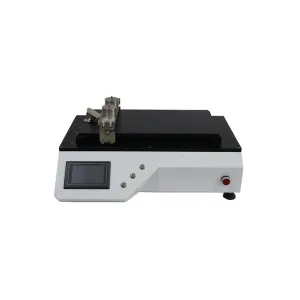
Планшетный тестер покрытий
Их классификация: Coating & Film Applicatorsмнения: 463номер:Время выпуска: 2026-06-04 15:18:03Планшетный тестер покрытий серии AT-TB-1100 — это прецизионное лабораторное устройство для нанесения покрытий, разработанное компанией Shandong Annimet и предназначенное для нанесения покрытий, клеев, термоплавких материалов и проводящих/наноматериалов на такие подложки, как бумага, нетканые материалы, стекло и металлическая фольга. Скорость нанесения покрытия регулируется в диапазоне 1–2000 мм/мин, эффективная площадь 300×400 мм. Он поддерживает несколько методов нанесения покрытия, включая ракель и проволочный стержень, а также предлагает варианты для стола вакуумной адсорбции и нагреваемой опорной плиты (RT-200°C). Сенсорное управление делает его идеальной заменой ручного спуска.
новости
классификация:
-
[industry news]5 факторов, которые следует учитывать при выборе лабораторно...
2026-06-17 16:33:37
случай
классификация:
Нет результатов поиска!
видео
классификация:
Нет результатов поиска!
скачать
классификация:
Нет результатов поиска!
вербовка
классификация:
Нет результатов поиска!
Рекомендуемые продукты
-
NEWS
Планшетный тестер покрытий
Узнать больше



 телефон