
 English
 Español
 Français
 العربية


roll-to-roll coater
A roll-to-roll coater is a specialized industrial machine used to apply thin, uniform layers of material onto flexible substrates as they move continuously from one roll to another. It is widely used in manufacturing processes that require high precision, consistency, and efficiency, especially in industries such as electronics, energy, packaging, printing, and advanced materials. The core principle of a roll-to-roll coater is to unwind a substrate from a supply roll, pass it through one or more coating stations, and then rewind it onto a take-up roll after the coating has been applied and dried or cured.One of the main advantages of a roll-to-roll coater is its ability to support continuous production. Compared with sheet-by-sheet processing, this method significantly improves throughput and reduces labor costs. It is particularly suitable for large-scale manufacturing of flexible films, metal foils, paper, textiles, and polymer substrates. Because the process is continuous, it can maintain stable coating quality over long production runs, making it ideal for products that demand high uniformity.A typical roll-to-roll coating system includes several key components. These may include unwind and rewind units, tension control systems, guide rollers, cleaning sections, coating heads, drying or curing units, and inspection systems. The tension control system is especially important because even slight changes in substrate tension can affect coating thickness, alignment, and surface quality. Guide rollers help maintain the correct web path, while cleaning units remove dust and contaminants before coating begins. The coating head is the central part of the machine, where the coating material is applied to the moving web.There are various coating methods that can be integrated into a roll-to-roll coater, such as slot-die coating, gravure coating, reverse roll coating, blade coating, and spray coating. The choice of method depends on the viscosity of the coating material, the desired thickness, the type of substrate, and the application requirements. For example, slot-die coating is often chosen for precise and controlled layer deposition, while gravure coating is suitable for high-speed applications and thinner layers.Drying or curing is another critical stage in the process. After the coating is applied, the substrate usually passes through thermal ovens, infrared dryers, ultraviolet curing systems, or other drying technologies. Proper drying ensures that the coated layer bonds well to the substrate and achieves the required mechanical, optical, or electrical properties. In many cases, the environment inside the coater must be carefully controlled to prevent defects such as bubbles, streaks, pinholes, or uneven thickness.Roll-to-roll coaters are used in many advanced applications. In electronics, they can be used to fabricate flexible circuits, display films, and conductive layers. In energy storage, they are important for producing battery electrodes and separator coatings. In packaging, they help create barrier films and functional surface layers. In research and development, roll-to-roll systems are valuable for testing new materials and scaling up laboratory processes into industrial production.Overall, a roll-to-roll coater is an essential tool for modern continuous manufacturing. It combines precision, speed, and scalability, enabling the efficient production of high-quality coated flexible materials for a wide range of applications.
продукт
классификация:
-
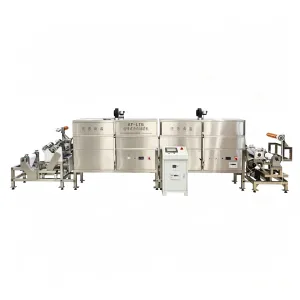
Тестер непрерывного покрытия
Их классификация: Coating & Film Applicatorsмнения: 389номер:Время выпуска: 2026-06-04 15:09:11Устройство для непрерывного нанесения покрытий предназначено для нанесения покрытий с рулона на рулон и ламинирования рулонных подложек. Он поддерживает как методы нанесения покрытия дозирующим стержнем, так и ножом, с эффективной шириной покрытия 280 мм и механической скоростью 0,2-2 м/мин. Оснащенный двумя сушильными печами (30-120°C ±2°C), системами размотки, намотки, ламинирования и электрическим управлением, он обрабатывает бумажные (60-120 г/м2) и пленочные (0,03-0,15 мм) подложки с использованием покрытий на водной основе или на основе растворителей. Это профессиональная платформа для исследований процесса непрерывного нанесения покрытий. -
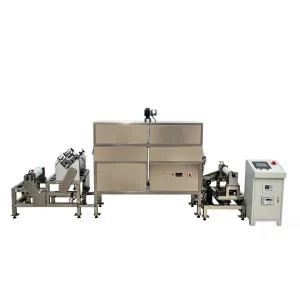
Многофункциональное устройство для нанесения покрытий
Их классификация: Coating & Film Applicatorsмнения: 584номер:Время выпуска: 2026-07-07 11:17:14Многофункциональная машина для нанесения покрытий — это система непрерывного нанесения покрытия и ламинирования с рулона на рулон, предназначенная для лабораторных исследований и разработок, а также для мелкосерийного пилотного производства гибких рулонных материалов, таких как бумага и пленка. Он имеет эффективную ширину покрытия 280 мм, ширину поверхности валика 300 мм и регулируемый диапазон механической скорости 0,5-5 м/мин. Установка для нанесения покрытий поддерживает модульное переключение между методами дозирующего стержня, лезвия, валика глубокой печати и метода переноса пленки. Диаметр размотки и перемотки составляет до 350 мм с воздушными валами 3 дюйма и автоматическим контролем натяжения, обеспечивая выравнивание кромок в пределах ± 2,0 мм. Система сушки состоит из двух внешних печей с электрическим подогревом из нержавеющей стали с центробежным вентилятором, циркуляцией горячего воздуха и точным контролем температуры от 30 до 120°C ±2°C. Вся линия управляется централизованно через сенсорный экран HMI, при этом серводвигатели приводят в движение секции покрытия и намотки в активной синхронизации. Всего Установленная мощность составляет около 6 кВт. Он идеально подходит для непрерывной разработки процессов нанесения покрытий и подготовки проб покрытий на водной основе и на основе растворителей, аккумуляторных суспензий, оптических пленок и клеев.
новости
классификация:
Нет результатов поиска!
случай
классификация:
Нет результатов поиска!
видео
классификация:
Нет результатов поиска!
скачать
классификация:
Нет результатов поиска!
вербовка
классификация:
Нет результатов поиска!
Рекомендуемые продукты
-
NEWS
Тестер непрерывного покрытия
Узнать больше -
NEWS
Многофункциональное устройство для нанесения покрытий
Узнать больше



 телефон